


Academic Test Prep & Subject Tutoring
“Can you help us?”
Students and parents often ask whether their student should take the ACT or the SAT. This usually depends on the student’s strengths and preferences.
At Milestone, students can take full proctored ACT and/or SAT tests to determine which test is better for them. Then, students can discuss prep alternatives with our Milestone staff. We make every effort to provide ACT Prep and SAT Prep options that fit various student needs, learning styles and budgets.

Many colleges continue to consider standardized test scores as one of many important factors in the admissions decision process. As such, achieving your best score can help you be more competitive. Plus, many scholarship opportunities are determined based on a student’s standardized test score. It makes good sense, then, to prepare!
Our experienced tutors at Milestone work to help each student gain the knowledge and skills necessary to achieve positive results. We offer individual tutoring to provide intensive skills building across all subject areas. In addition, at Milestone, we have vast standardized test resources and many small study rooms that are distraction free. Plus, students can take unlimited practice tests in a simulated environment. There are many ways to prepare and our Milestone experts can help you find the best solution for you.
How Can Test Prep Help Me?
Our Services

-
During this 90-minute session, students meet one-on-one with two specialists (45 minutes per tutor). One tutor focuses on Reading/English sections, while the second tutor works on Math sections.
-
Flexible, expert advice when you need it. Book hourly support across a range of topics—from planning to problem-solving. This focused consultation will help clarify your goals, map out next steps, and identify opportunities for growth.
-
Proctored timed practice sections (ACT or SAT) are offered on Saturdays from 12:00 pm to 3:00 pm. Registration is required.
Full Proctored Practice tests and Baseline Tests are offered on Saturday and Sunday mornings at 9:00 am. Registration is required.
Most accommodations can be met. Please call our office to schedule.
*All tests can be administered remotely
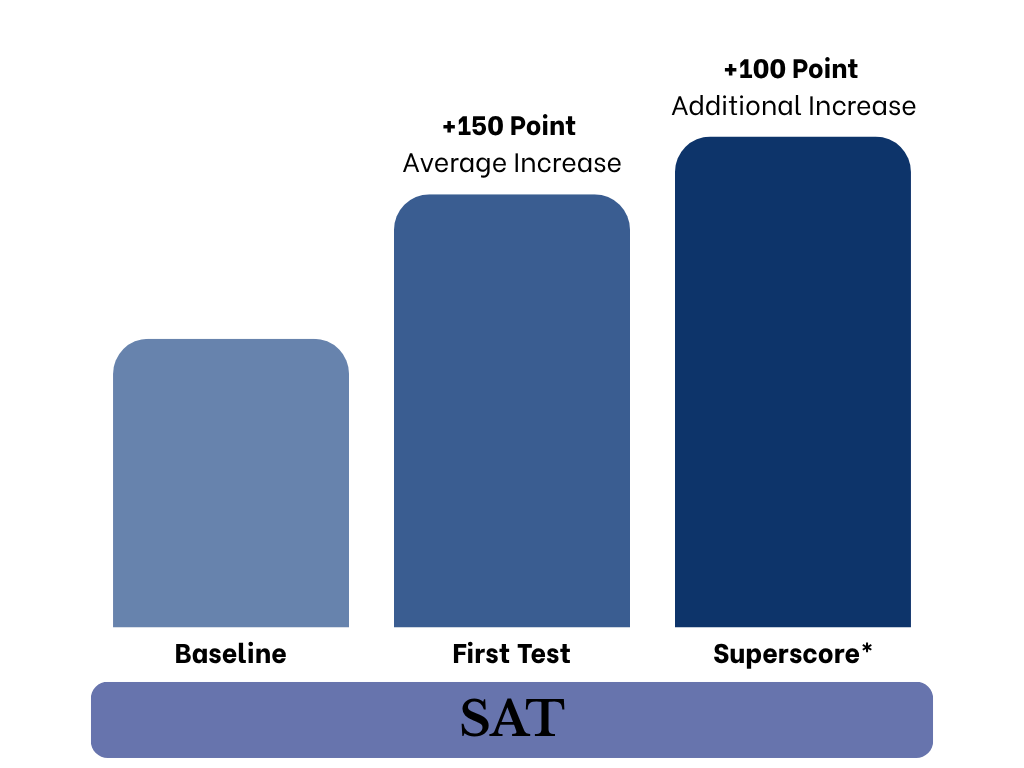

*Students used in data averaged between 2-3 official tests.
Data reflects students who completed a minimum of 16 test prep sessions and participated in consistent simulated practice testing.
ACT & SAT Test Dates
2026 - 2027
SAT
August 28, 2026
September 18, 2026
October 23, 2026
November 20, 2026
February 19, 2027
April 16, 2027
May 21, 2027
Application Due
Test Date
September 12, 2026
October 3, 2026
November 7, 2026
December 5, 2026
March 6, 2027
May 1, 2027
June 5, 2027
ACT
August 14, 2026
September 11, 2026
November 6, 2026
January 22, 2027
March 5, 2027
May 7, 2027
June 4, 2027
Application Due
Test Date
September 19, 2026
October 17, 2026
December 12, 2026
February 27, 2026
April 10, 2027
June 12, 2027
July 10, 2027
Subjects We Tutor
Mathematics
College Algebra
Algebra 1
Geometry
Algebra 2
Trigonometry
Pre Calculus (AP/H/Reg)
AP Calculus AB
AP Calculus BC
Statistics (AP/H/Reg)
Science
Biology (AP/H/Reg)
Chemistry (AP/H/Reg)
Anatomy
Physics 1 (AP/H/Reg)
Physics 2 (AP/H/Reg)
Social Science
Economics
AP Macroeconomics
AP Microeconomics
English
Writing
AP Language
Literature (AP/H/Reg)

Frequently Asked Questions
-
The SAT is available only online unless you have accommodations that specify a paper format. Online format does include Desmos Graphing Calculator.
The ACT can be taken either online or on paper. But only for the online format are you allowed to use the Desmos Graphing Calculator.
-
Yes. Recent changes have made this much more accessible for families. In July 2025, Congress passed new tax legislation that expanded the use of 529 plans. Parents can now withdraw funds tax-free to cover tutoring, standardized test prep, and even educational therapy for K–12 students.
For many families, this can translate to a 25% or more reduction in the cost of tutoring or test prep, depending on their tax situation. As always, it’s a good idea to confirm details with your financial advisor or 529 plan provider to understand how these changes apply to your specific situation.
-
It is almost always a good idea for your child to attempt standardized testing. Competitive SAT or ACT scores can strengthen an application, open doors to more selective schools, and even lead to valuable merit scholarship opportunities.
That said, many excellent colleges now offer test-optional policies. If your child’s scores fall below the typical range for a given school, choosing not to submit them can be a smart strategy.
In most cases, the decision to apply test-optional should be made after your child has taken an official test and seen their results—not before. This ensures you’re making an informed choice based on real data, rather than limiting opportunities prematurely.
-
Test prep can make a significant difference. With the right approach, students become more familiar with the test, improve timing, and learn strategies that lead to higher scores.
Based on our experience working with students at Milestone, most see meaningful improvement over time. On average, students improve 200–250 points on the SAT and 6–8 points on the ACT across 2–3 official test attempts.
The key is consistent, targeted preparation combined with a thoughtful testing plan.
-
No, we cannot make any guarantee’s because test prep is a program that requires the student to participate.
When we see strong motivation, we definitely see score improvement.
No improvement can happen without proper work by both parties.
-
Superscoring means a college takes your highest section scores across multiple test dates and combines them into a new, higher composite score.
Many colleges superscore, but not all. Always check each school’s policy.
-
No. The Science section is no longer required as part of the ACT, and most colleges do not consider the science score in admissions decisions. However, there are still a small number of schools that do require a science score. Because of this, it’s important to carefully review the testing requirements for every college your child is considering.
If your child does not yet have a clear college list, it may be wise to take the Science section to keep all options open.
-
ACT:
SAT:
SSAT:
PSAT:
CLT:
-
Ideally, students should begin test prep 2–3 months before their first official test. This provides enough time to build skills, learn strategies, and gain confidence without feeling rushed.
It’s also important to remember that most students will take the SAT or ACT more than once. Because of this, prep should be viewed as a process over time, not a one-time push.
While starting early can be helpful, starting too early can lead to burnout, especially if a student hasn’t yet completed the academic coursework that appears on the test. The goal is to find a balance: begin early enough to prepare effectively, but not so early that your child becomes fatigued or disengaged before test day even arrives.
-
The best way to decide is to take a diagnostic, or baseline, test for both exams. Some students naturally perform better on one due to pacing, question style, or strengths in math vs. reading. We generally recommend taking baseline tests once a student has completed all (or at least most) of Algebra 2.
There’s no universal “better” test—only the better fit for your student.